
Overview
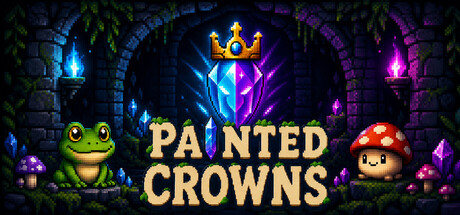
Painted Crowns drops you into a ruined world where a miracle cure—The Ink—became a living disaster known as the Long Spill. From the village of Frogshroom, you descend into buried reservoirs where the catastrophe began, fighting through procedurally assembled floors, uncovering sealed histories, and choosing which crown (if any) deserves your loyalty.
At its core, this is a brisk, combat-forward dungeon descent built around a standout twist: red/blue color swapping that turns every encounter into a quick read-and-react puzzle.
Setting: Every Crown Leaves a Stain
The Ink was created to heal a dying world, shaped by different cultures—frogs gave it renewal, mushrooms gave it memory—until rulers fought over ownership. That power struggle didn’t just scar the land; it reshaped it. Your run becomes a tour through the aftermath: a dungeon that feels like a sealed-off wound, layered with rival claims and consequences.
What makes the premise land is how it feeds into player choice. Your actions echo upward to the powers that still care about what happened down below.
Combat That’s About Color, Timing, and Control
Painted Crowns plays from a top-down perspective with fast pixel-art action. Encounters lean into dense projectile patterns, quick repositioning, and tight windows where choosing the correct color is the difference between a clean clear and a scramble.
- Swap red/blue to counter defenses: Enemies aren’t just health bars—your current color matters, and switching at the right moment can open damage windows or prevent wasted attacks.
- Dash to survive patterns: Mobility is central, letting you cut through bullet-hell-ish formations and reset spacing when rooms get crowded.
- Precision stuns and reload timing: The game rewards clean execution—well-timed stuns to create openings and mechanical mastery that compounds as the dungeon escalates.
- Ordered eliminations for better rewards: Some enemies are “numbered,” pushing you to prioritize targets in sequence to maximize payouts, turning chaotic rooms into risk/reward routing challenges.
Lethal vs Nonlethal Runs: A Real Build Choice, Not a Gimmick
A defining hook is that enemies don’t always have to die. You can invest in stun-focused play and aim for a nonlethal descent, or go lethal and live with the reputation you build. This isn’t framed as a simple “good/evil” slider—more like a tactical and narrative commitment that changes how you approach rooms.
It also extends beyond enemies: dungeon inhabitants can be rescued, ignored, or killed, and the Frog Court and Mushroom Crown will remember. If you enjoy roguelikes where the run’s story is partially authored by your moment-to-moment decisions, Painted Crowns is built to support that.
Procedural Floors That Push Back
Runs are stitched from procedurally assembled rooms with shifting enemy combinations, secrets, breakable props, treasure, and quests. The structure is designed to become more hostile the deeper you go—less a gentle ramp and more a deliberate squeeze that demands cleaner movement and faster reads.
Content-wise, expect twelve dungeon floors across four regions, with bosses and “hidden depths” that reward players who probe for secret chambers and challenge clears (like flawless fights).
Progression and Customization: Build Your Champion
Between runs, you’ll steadily expand your options through permanent upgrades and unlockables. During runs, you’ll gather Ink, coins, and equipment to shape a build—whether you want raw damage, movement mastery, or a kit that emphasizes stun control.
- Unlockables: new playable characters, weapons, hats, and pets
- Build directions: high firepower, evasive mobility, or stun-centric control
- Challenge layers: secret rooms, ordered eliminations, flawless clears, and difficult achievements
- Difficulty options: multiple settings including Impossible Mode
Why It Plays Well on Mac
Painted Crowns’ pixel-art presentation and top-down readability are a strong match for Mac setups, including integrated graphics—especially when paired with Metal compatibility. The action focus means smooth performance matters more than sheer GPU horsepower, and the listed requirements are approachable for a wide range of Macs.
Mac System Requirements
Minimum
- OS: macOS 10.15 Catalina or later
- Processor: Intel Core i3, Apple M1, or equivalent
- Memory: 4 GB RAM
- Graphics: Metal-compatible integrated graphics
- Storage: 2 GB available space
- Sound Card: Integrated audio or compatible external audio device
- Additional Notes: Requires a 64-bit processor and Metal-compatible graphics. Apple Silicon systems may require Rosetta 2 depending on the build architecture.
Recommended
- OS: macOS 12 Monterey or later
- Processor: Intel Core i5 or Apple M1
- Memory: 8 GB RAM
- Graphics: Intel Iris graphics, Apple Silicon integrated graphics, or better
- Storage: 2 GB available space
- Sound Card: Integrated audio or compatible external audio device
- Additional Notes: Requires a 64-bit processor and Metal-compatible graphics. Apple Silicon systems may require Rosetta 2 depending on the build architecture.
Who It’s For
- Players who like action roguelikes with mechanical hooks deeper than “get upgrades, do more damage.”
- Anyone who enjoys bullet-pattern dodging and fast room clears.
- Roguelike fans who want choice and consequence baked into moment-to-moment play (lethal vs nonlethal, factions tracking decisions).
- Completionists looking for flawless clears, secrets, and challenge modes.
Bottom Line
Painted Crowns blends fast top-down combat with a clever red/blue swapping layer that keeps fights tactical even when the screen fills with threats. Add meaningful nonlethal options, faction reputation, and a multi-region descent that gets nastier the deeper you go, and you’ve got a Mac-friendly roguelike that’s built for repeated runs—and for players who like their skill checks sharp.

Comments
Sign in to join the conversation.
Log in to commentNo comments yet. Be the first to join the conversation.