

PROJEKT GODHAND on Mac: a rhythm game about playing dirty (on purpose)
Most rhythm games are built around discipline: clean timing, correct lanes, and the kind of precision that makes you sit up straight and sweat. PROJEKT GODHAND goes the other way. It’s an 8-button rhythm game that proudly sells itself as “tool assisted bullshitting,” giving you a ruleset designed to feel like you’re cheating your way through brutally dense charts—without hiding that it’s the whole point.
The core fantasy is simple: you’re still reacting to fast patterns and demanding songs, but the game hands you a set of absurdly forgiving inputs so you can focus on momentum rather than perfection. If your idea of fun is controlled chaos, score-chasing through a cloud of keypresses, and laughing at the sheer audacity of it all, GODHAND is aimed directly at you.
How it plays: eight buttons, half-keyboard logic, and sanctioned nonsense
At its heart, PROJEKT GODHAND is a tough rhythm game that pretends to remove the “tough” part by letting you blur input accuracy:
- Wrong key? Kind of fine. The game encourages a “close enough” approach where any key on the same half of your keyboard can count for the intended button in many situations.
- Fast streams? Chord them. Instead of perfectly alternating individual notes at high speed, the game encourages you to slam chords to bulldoze through sections that would normally demand immaculate single-tap control.
- The real skill becomes output management. When accuracy is loosened, your challenge shifts toward reading patterns, keeping time, and controlling your impulse to over-input.
It’s a clever inversion: the game removes some traditional friction while adding a different kind—how hard can you mash without losing control?
The Heat Gauge: the limiter that turns mashing into strategy
Of course, if the game lets you smash anything and still survive, it needs a governor. That’s where the Heat Gauge comes in. Inputs fill the gauge, and too many inputs push it upward.
The joke—and the twist—is that the heat system doesn’t simply punish you. It’s framed as something that can vastly increase your score, which turns reckless playing into a high-risk scoring tool. In other words, PROJEKT GODHAND doesn’t just tolerate messy play; it gamifies it.
For Mac players used to traditional “combo or die” scoring, the Heat Gauge is the mechanic that makes GODHAND feel distinct. You’re not only trying to keep time—you’re riding a line between aggressive input spam and keeping things stable enough to not implode.
Soundtrack and content: 50+ songs and collab energy
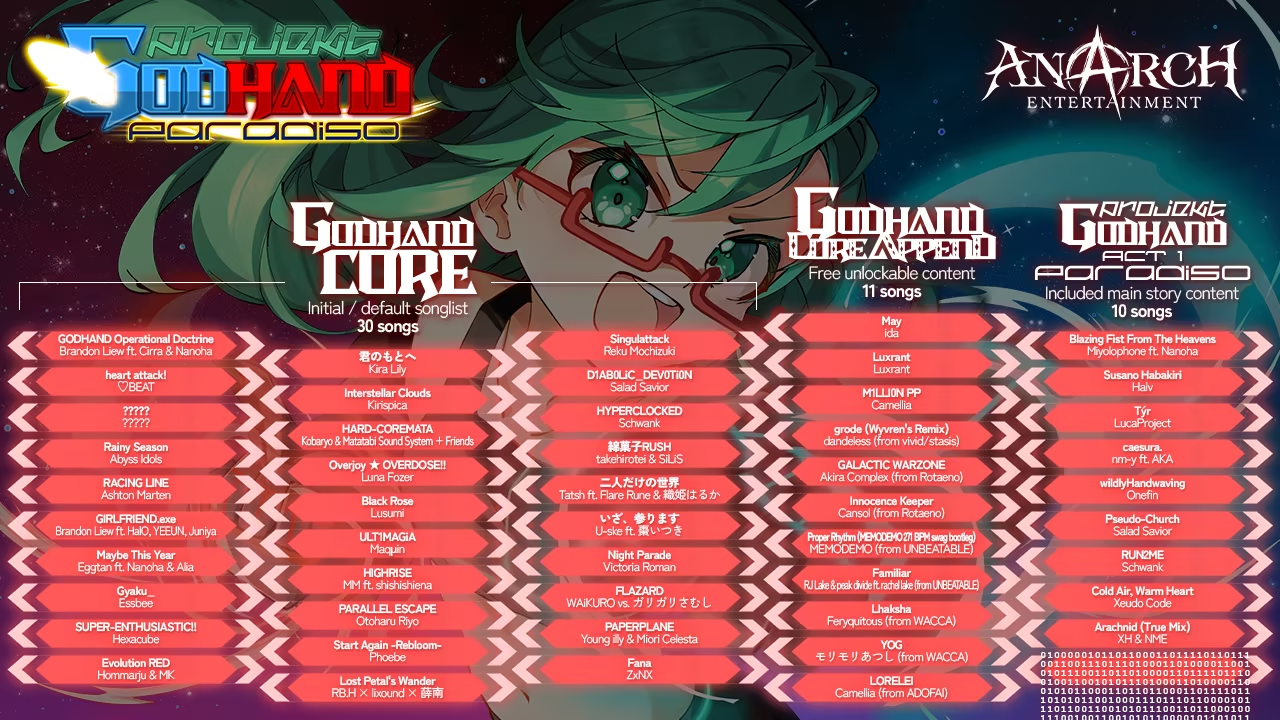
PROJEKT GODHAND comes packed with over 50 songs in its base content, and it leans into the modern rhythm ecosystem of collabs and scene crossover. The game calls out collaborations with:
- vivid/stasis
- Rotaeno
- UNBEATABLE
- WACCA
- ADOFAI
The vibe here is maximalist: music-forward, community-aware, and built for players who want a big library to chew through rather than a short campaign you finish and forget. If your tastes overlap with internet music culture (including the very real possibility it includes at least one VTuber you follow), this is the kind of tracklist philosophy that will make immediate sense.
On Mac: what to expect (and what to plug in)
Rhythm games live and die by responsiveness, and while PROJEKT GODHAND’s design is intentionally forgiving, it still rewards tight timing and consistent inputs. On macOS, that means two practical considerations:
- Use an external keyboard if you can. The game itself jokes about keyboard destruction, but there’s a real ergonomic point underneath: you’ll be pressing a lot of keys, fast, and hard.
- Prioritize stable performance. Close background apps, aim for steady frame pacing, and consider playing in a setup that minimizes input latency.
Mac system requirements
Minimum
- OS: Big Sur 11 or newer
- Processor: Apple Silicon, x64 architecture with SSE2
- Memory: 2 GB RAM
- Graphics: Metal capable Intel and AMD GPUs
- Storage: 4 GB available space
- Additional Notes: Apple keyboards are pretty expensive. The developer strongly suggests using an external mechanical keyboard (and does not take responsibility if you ignore that advice).
Recommended
- (Not specified)
Who is PROJEKT GODHAND for?
- Rhythm veterans who want something self-aware and different from strict lane accuracy.
- Score chasers who enjoy systems that reward risk, volatility, and pushing meters to the edge.
- Players who love chaotic execution—the people who grin when a game says “sure, hit the chord” and means it.
And who should skip it? If you want a pure precision simulator where the joy is nailing the exact correct button every time, the whole premise of GODHAND may feel like heresy. That’s not a flaw—it’s the identity.
The takeaway
PROJEKT GODHAND is a rhythm game that turns “playing wrong” into a legitimate technique. It’s loud, fast, and deliberately un-serious about input purity, while still offering the kind of intensity that makes rhythm games compelling. On Mac, it’s easy to recommend to anyone craving a big song list and a fresh mechanical hook—just do yourself a favor and bring a sturdy external keyboard.
(If you destroy your keyboard in the game, you destroy your keyboard in real life.)



Comments
Sign in to join the conversation.
Log in to commentNo comments yet. Be the first to join the conversation.