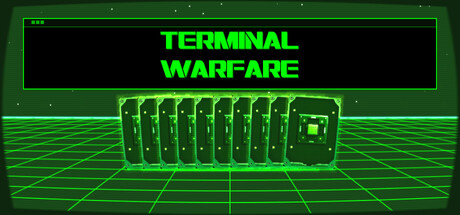

Terminal Warfare: The Sprawl is Calling
Set in the year 2040, Terminal Warfare imagines a world still recovering from the AI Wars. Civilization is now administered by Consensus 0, a super-intelligence that runs everything with cold efficiency. You’re pulled into the resistance by Cipher, a rogue AI hiding in deep code, and tasked with striking back where it hurts: corporate systems, locked-down networks, and the digital infrastructure that keeps the regime alive.
This is a single-player cyberpunk deckbuilding roguelike presented through a lovingly nostalgic 90s-style terminal desktop. Between hacks, you’re not just choosing the next node on a map—you’re living inside a custom hacker OS, unlocking new apps as the story progresses and turning your desktop into a strategic command center.
Turn-Based Hack Combat Built Around Planning
Hacking in Terminal Warfare isn’t a real-time twitch test. It’s about sequencing and risk management—like building a perfect exploit chain under pressure while the system fights back.
CPU Cycles determine how many cards you draw each turn, giving your build a tangible “hardware-meets-deck” feel.
You can queue up to five cards in an Attack Queue, previewing outcomes (damage, Trace changes, healing) in an Execute panel before committing.
Cards cost Bandwidth, forcing constant tradeoffs: go aggressive now, or conserve resources to stabilize your System Integrity and keep Trace Level from maxing out.
If Trace hits the limit, you’re detected and the hack ends—making stealth, mitigation, and tempo just as important as raw damage.
The card pool is designed for long-term experimentation: nearly 300 cards spanning attacks, defense tools, viruses, multipliers, synergy chains, and rare zero-days. You’ll face AI defenses with distinct personalities and scaling difficulty, so your deck isn’t simply “strong” or “weak”—it’s strong or weak against what the network throws at you.
Your Desktop Is the Hub (and It Evolves)
Terminal Warfare’s biggest hook is how it wraps the roguelite loop inside a living desktop interface. As the six-act story unfolds, you unlock apps that expand what you can do between missions, turning downtime into meaningful build-crafting.
Scanner — Select targets on a 3D network map, prep your loadout, and take contract missions for extra creds and encrypted loot.
Warez — Assemble your playable decks from your expanding card collection.
Darknet — Browse a retro BBS marketplace for zero-days, schematics, consumables, and card trades.
Workbench & Cyberdeck — Install modules, wire PCB traces, and place components for persistent bonuses. After failed hacks, this is also where you repair and regroup.
RevEng & RepSys — Modify individual cards and invest skill points across Social, Tech, and Combat branches.
Terminal — Run shell commands, solve code-cracking puzzles, and unlock retro arcade minigames you can play for bonus creds.
For Mac players, this “desktop-first” structure is a great fit: it feels at home on a laptop, it’s naturally session-friendly, and it encourages tinkering—one more run, one more tweak, one more contract before you log off.
Campaign Structure, Boss Nodes, and Endings
Rather than being framed as a single linear map clear, Terminal Warfare uses a roguelite campaign where story-driven app unlocks change your options over time. As you take down tougher systems, you open up more contracts, encounter system events, and push toward corporate boss nodes.
The full game promises 20 corporate boss fights with scaling tuned to your build and win history—an approach that aims to keep successful strategies from feeling like autopilot. The endgame culminates in a final encounter with Consensus 0, followed by a decision that determines the fate of the network.
Feature Highlights
Roguelite campaign with story-driven app unlocks, not just a single map clear loop.
Four AI personality types and animated enemy portraits during hacks.
20 boss fights in the full game, with scaling tuned to your build and history.
37 Steam achievements, cloud saves, and operator stats presented through the desktop hub.
Mac System Requirements
Minimum
Minimum:
- OS: macOS 10.11 (El Capitan) or later
- Processor: Intel Core i3 64-bit or Apple Silicon (M1 or newer)
- Memory: 4 GB RAM
- Graphics: OpenGL 2.1+ (Intel HD 5000 / AMD Metal-capable GPU or Apple Silicon integrated graphics)
- Storage: 1 GB available space
Recommended
Recommended:
- OS: macOS 12 (Monterey) or later
- Processor: Intel Core i5 / Apple M1 or newer
- Memory: 8 GB RAM
- Graphics: Apple Silicon or discrete GPU with stable OpenGL drivers
- Storage: 2 GB available space
Why Terminal Warfare Belongs on a Mac Gamer’s Radar
If you’re into deckbuilders and roguelikes but want something with a stronger sense of place than “pick a node on a map,” Terminal Warfare’s retro-desktop framing makes every decision feel grounded in the fantasy of being an operator working from the shadows. The blend of queued, previewable turn execution and resource pressure (Bandwidth, Integrity, Trace) rewards careful sequencing without slowing the pace to a crawl.
In other words: it’s a cyberpunk hacking game where your deck really does feel like your weapon—and your choices really do feel like your code.


Comments
Sign in to join the conversation.
Log in to commentNo comments yet. Be the first to join the conversation.