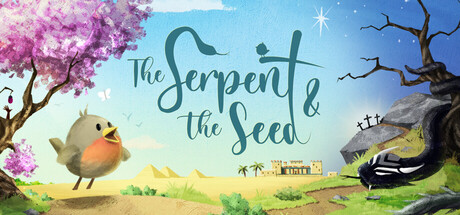

The Serpent & The Seed is the kind of game that feels less like a traditional “quest” and more like an illustrated storybook you can step into. Built as a poetic narrative adventure, it retells the Bible’s grand storyline—from Eden through Revelation—using hand-drawn environments, understated but meaningful interactive puzzles, and an original soundtrack by US indie folk duo Poor Bishop Hooper.
You play as Mungo, an adorable robin who becomes your guide through a world that’s both beautiful and burdened: overgrown with thorns, echoing with loss, and shadowed by the image of a Serpent on the throne. The game’s approach is deliberately reflective. It aims to evoke wonder and melancholy as much as curiosity, inviting you to slow down, observe, and connect ideas across scenes rather than rush to “win.”
Story and Themes
Where many narrative adventures focus on a single mystery or a tight character drama, The Serpent & The Seed goes panoramic. It frames its journey as a sequence of moments that build toward a long-form promise—moving from beginnings to endings, from innocence to exile, and from fracture to hope.
Importantly, the game positions itself as approachable whether you’re deeply familiar with the Bible or encountering these stories for the first time. It’s not structured like a quiz on scripture knowledge. Instead, it uses visuals, tone, symbolism, and interactive vignettes to communicate meaning. The result is a narrative that can be read devotionally, artistically, or simply as mythic storytelling—depending on what you bring to it.
Gameplay: Gentle Puzzles and Mini-Games
Moment-to-moment interaction is designed to be calm and purposeful. You’ll explore hand-crafted spaces, engage with light puzzle mechanics, and encounter mini-games that function as thematic punctuation marks—small interactions that reinforce the emotional beat of a scene.
This is not a systems-heavy puzzle game where difficulty is the main attraction. The emphasis is on atmosphere and interpretation: noticing details, moving through spaces with intention, and letting the game’s imagery do its work. If you enjoy narrative adventures that prioritize mood (think “walk-and-wonder” pacing with occasional tactile interludes), this will likely land well.
Art Direction: Hand-Drawn, Painterly, and Symbolic
The standout feature is the presentation. The world is rendered in visually rich hand-drawn art that leans painterly and storybook-like, but often with an edge of unease—thorns, ruins, and stark contrasts that underline the themes. The environments feel curated rather than procedurally “gamey,” like each location was composed to communicate an idea.
Mungo, as your on-screen presence, helps set the tone: small, living, and vulnerable against vast scenes. It’s a smart choice for a game about witnessing history and hope from the ground level.
Music and Sound: Poor Bishop Hooper’s Haunting Score
Music is not a background afterthought here—it’s a pillar of the experience. The original dynamic soundtrack by Poor Bishop Hooper is described as haunting, and it earns that label through restraint: melancholic textures, folk inflections, and a sense of reverence that complements the game’s reflective pacing.
For Mac players in particular—often drawn to indie titles where music and art do heavy narrative lifting—this is the kind of score that can turn exploration into something quietly unforgettable.
Who It’s For (and Who It Isn’t)
- Play it if: you love narrative-driven indies, hand-drawn visuals, emotionally resonant journeys, and gentle puzzles.
- Also play it if: you’re curious about biblical storytelling presented as interactive art—whether from faith, literature, or mythic-history interest.
- Skip it if: you want deep mechanical complexity, fast pacing, or puzzle difficulty as the main challenge.
Notable Feature Highlights
- A sweeping narrative journey from Eden to Revelation
- Visually breathtaking hand-drawn environments
- Original dynamic soundtrack by Poor Bishop Hooper
- A reflective, emotionally rich experience
“It’s absolutely beautiful and compelling” — The Rt Revd Jill Duff, Anglican Bishop of Lancaster
Mac System Requirements
Minimum
- OS: OS X 10.15 or later
- Processor: Apple or Intel processor
- Memory: 4 GB RAM
- Graphics: Graphics card with 128 MB of RAM
- Storage: 2 GB available space
Recommended
No recommended specifications were provided.
MacGaming.com Take
The Serpent & The Seed is an artful, contemplative narrative adventure—one that trusts imagery, music, and symbolism to carry its story. On Mac, it looks positioned to be a low-spec-friendly indie experience (at least on paper) with high-impact presentation. If you’re in the mood for something short on noise and long on meaning, this is a journey worth considering.



Comments
Sign in to join the conversation.
Log in to commentNo comments yet. Be the first to join the conversation.