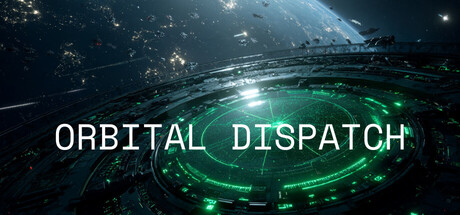

Orbital Dispatch puts you in the hot seat of a frontier outpost
Orbital Dispatch casts you as the dispatch operator for Orbital Outpost Kepler-4, humanity’s furthest waypoint on a rim trade corridor where every ship in orbit is someone else’s problem—until it becomes yours. Your day-to-day sounds routine: guide civilian traffic to docking, scan suspicious holds, reject contraband, and keep station operations stable. Then the situation curdles. Pirates stop posturing and start burning straight for your hull, and later… something stranger arrives.
Core loop: DOCK. SCAN. SURVIVE.
The game’s appeal is its pressure-cooker rhythm. You’re managing incoming traffic in real time, juggling multiple priorities at once:
- Route civilian ships safely to the docking ring to keep commerce flowing.
- Scan suspicious vessels before clearing them—miss contraband and you pay; reject an innocent trader and you pay even more.
- Respond to attacks by dispatching security drones to intercept hostiles before they slam into the station.
It’s a satisfying blend of traffic control, risk assessment, and rapid triage—where doing the “right” thing is often less important than doing the necessary thing before the next crisis hits the board.
Escalating threats that change how you play
Orbital Dispatch doesn’t just increase numbers as difficulty ramps; it adds new problems that force different habits and priorities. As shifts progress, you’ll face:
- Smugglers hiding contraband in normal traffic—scan carefully or eat the fines.
- EMP smugglers that can detonate when scanned, triggering blackouts that disrupt your ability to operate.
- Parasite carriers that infect nearby ships in orbit—dock the wrong vessel and you’re paying for it in hull damage.
- Juggernauts that can shrug off a single drone hit, demanding more committed defense.
- Warlords that jam callsigns and conceal escorts, muddying the information you rely on to make fast decisions.
- Dreadnoughts that arrive like a statement, backed by an entire pirate fleet.
- Aliens that phase-jump unpredictably, bypassing conventional expectations of interception and positioning.
- The Hivemind, commanding the alien swarm and acting as the culmination of that arc.
The result is a steady feeling of your procedures being challenged: what worked earlier becomes risky later, and “safe” choices can become liabilities when enemy behavior changes.
Upgrades between shifts: operations, defense, economy
Between shifts, you’ll spend limited credits on upgrades across three categories. The tension here isn’t in finding a perfect build—it’s in committing to a plan with incomplete certainty, because everything competes for the same budget.
- Operations: Faster scanning, auto-scanners, longer shifts, fuel depots.
- Defense: Reinforced hull, hull repair, faster drones, EMP shielding.
- Economy: Cheaper drones, cargo manifests, insurance, contraband bounties.
Skipping an upgrade is rarely neutral; it’s choosing which future emergency you’re willing to absorb when the pace spikes.
A comms-driven narrative across 30 shifts
Orbital Dispatch tells its story through what you’d expect on a working station: comms chatter, briefings, warnings, and bad news from command. The cast—Commander Kovacs, Lt. Mira, Kestrel-7, Dr. Voss, and Sector Fleet Command—gives each shift context and escalation without pulling you away from the job.
The narrative spans 30 shifts, building from piracy and consolidation under a warlord to dreadnought-level assaults, before pivoting into first contact with something beyond the system.
Modes, meta, and replayability
Beyond the structured arc, Orbital Dispatch supports endless shifts with escalating difficulty and high score tracking, encouraging mastery of your routing, scanning discipline, and defensive timing. A ship codex tracks encountered threats, and the game includes 26 Steam achievements for completionists.
Presentation: retro radar vibes with modern clarity
The game leans into a retro radar / CRT-style aesthetic, a fitting match for the fantasy of running a high-stakes orbital control board. It’s readable, thematic, and reinforces the sense that you’re watching a living perimeter—one blip at a time—trying to prevent the station from becoming a wreck.
Key features at a glance
- Endless shifts with escalating difficulty
- 3 unique boss encounters: Warlord, Dreadnought, Hivemind
- 15 ship types spanning civilians, smugglers, pirates, aliens, and bosses
- 21 upgrades across operations, defense, and economy
- Real-time ship management: dock, scan, reject, dispatch
- Phase-jumping alien enemies with unique movement
- 7 voiced characters with a full narrative arc
- Shift events including fuel leaks, contraband surges, sensor blackouts, and solar flares
- Ship codex, high score tracking, Steam Cloud sync
- Localized in 9 languages
Mac system requirements
Minimum
- OS: macOS 10.15 (Catalina)
- Processor: Intel Core i3 / Apple M1
- Memory: 4 GB RAM
- Graphics: Integrated graphics
- Storage: 1500 MB available space
Recommended
- OS: macOS 12 (Monterey)
- Processor: Intel Core i5 / Apple M1
- Memory: 8 GB RAM
- Graphics: Integrated graphics
Verdict for Mac gamers
If you like management games that feel like a job in the best way—clear procedures, rising stakes, and the constant fear that one overlooked detail will cascade into disaster—Orbital Dispatch is built for that adrenaline. It’s equal parts traffic control, security screening, and crisis response, wrapped in a sci-fi escalation curve that promises one thing by the end of every shift: the station does not fall.





Comments
Sign in to join the conversation.
Log in to commentNo comments yet. Be the first to join the conversation.